
Login
Welcome back! Login with your phone number.
By continuing, you agree to our Terms & Privacy Policy.
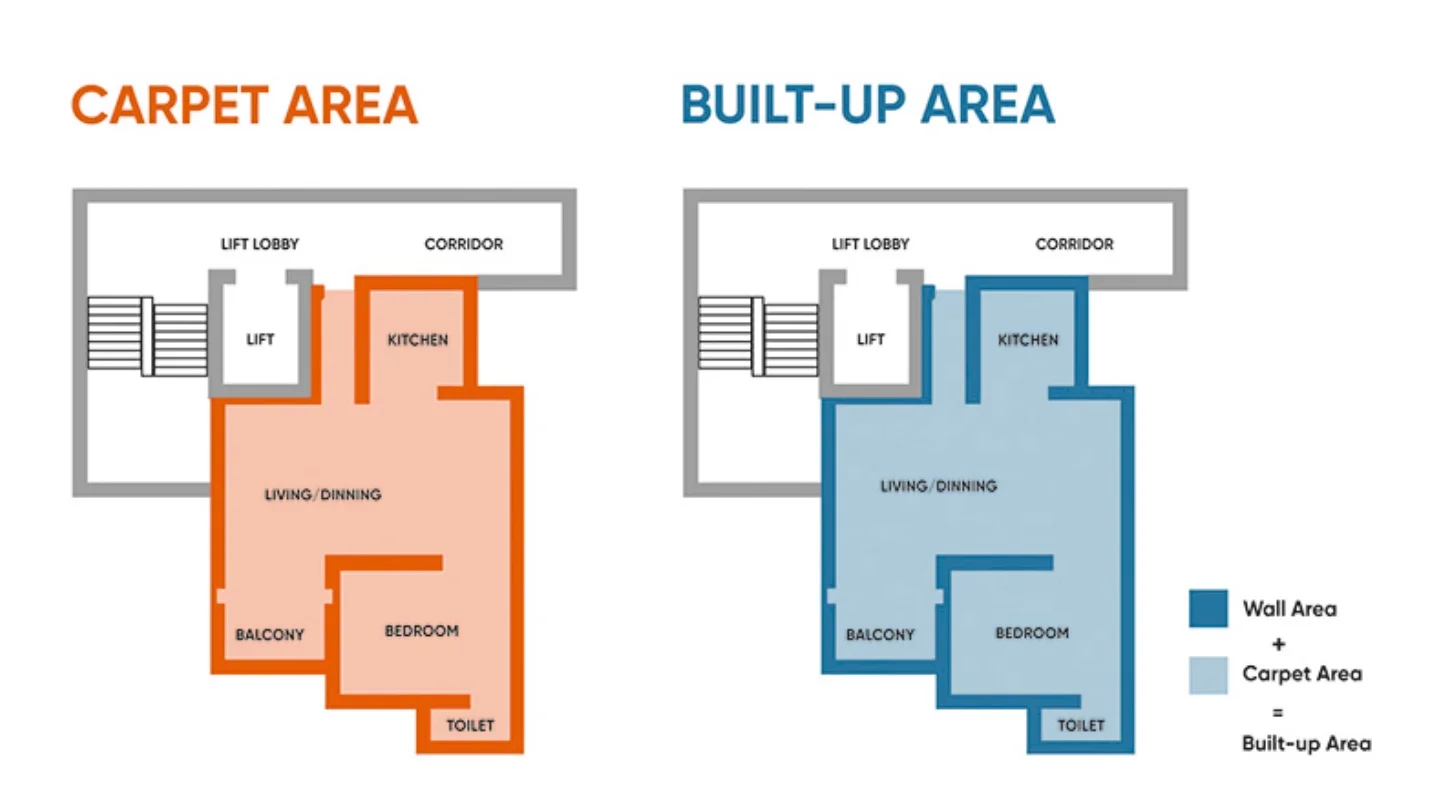
A builder says "1,000 sq ft flat". Which 1,000 sq ft? It could be the floor you'll walk on, or it could include your share of the lift, the lobby and the clubhouse. That gap is often 20 to 30 percent of the size you thought you were buying, and you pay for every foot of it.
This guide explains carpet area vs super built-up area in plain words, shows you how to work out the rate you really pay, and lists what to ask before you sign. We read two bank explainers for the facts. Where they disagree, we say so.
So when you compare buildup vs carpet area vs super built up area, you're really asking how much of the number on the brochure is inside your front door.
There are three measures, and each one is bigger than the last. Think of them as layers around your flat.
Only the common-area share changes. Take two flats with the same built-up area. One is in a plain building. The other is in a building with a big clubhouse and a pool. The second flat will have the larger super built-up area, and the higher price tag, for the same space inside.
You may also see "covered area" in an ad. The bank explainers don't define it, and sellers don't always use it in the same way, so ask what it includes. In practice it's often used to mean built-up area, but get it in writing. If the seller can't tell you which of the three measures it is, ask for the carpet area and use that.
The link between the two is the loading factor, which is the extra area added to your carpet area to cover common spaces. One bank explainer says it generally runs between 20% and 30% of the carpet area. The other says a loading factor of 1.30 is considered sufficient in most cases. A project with a lot of amenities loads more than a plain building.
As a percentage of what you pay for, here is what that means. At 20% loading, your carpet area is about 83% of the super built-up area. At 25% it's 80%, and at 30% it's about 77%. So at 25% loading, one in every five feet you pay for is not inside your flat. Some sources online quote higher loading, so ask for the actual figure on your project.
You don't need a tool. The formula is:
Super built-up area = carpet area × (1 + loading factor)
To go from super built-up area to a carpet area, divide instead: carpet area = super built-up area ÷ (1 + loading factor).
Here's an example, with made-up numbers for illustration only. A flat is quoted at ₹40 lakh on 1,000 sq ft of super built-up area, which sounds like ₹4,000 per sq ft. With 25% loading, the carpet area is 1,000 ÷ 1.25 = 800 sq ft. The same ₹40 lakh is now ₹5,000 per sq ft of carpet area.
Builders like to quote the lower-looking number. A rate on super built-up area looks cheaper per sq ft than a rate on carpet area, even when the total price is the same. So when you compare flats, compare the cost per sq ft of carpet area. If a builder only gives you the super built-up rate, ask for the carpet area and divide the example above.
After the RERA Act, builders have to sell on carpet area and show it in the brochure and the agreement. This applies across India, and both bank explainers say the same. They also say RERA limits how much the carpet area can increase to 3%. If the final carpet area comes out different from what's in your agreement, check what the agreement says about adjusting the price or refunding the difference, and ask a lawyer to confirm. For a builder project in UP, our guide to the UP RERA project check shows how to verify the record.
One caution on the sources: one bank page mixes up its own formulas, counting balconies in carpet area in one place and leaving them out in another. We've used the definition both banks agree on, where balconies and open terraces are out.
If you're buying an apartment with a loan, remember the bank's valuer will measure the flat. If their carpet area is different from the builder's, raise it with the builder and renegotiate. Once the price is settled, our home loan EMI guide will help you plan the payments.
Loading doesn't apply to land. Plots are sold by land area, usually in gaj, where one gaj is one square yard, or about 9 sq ft. You can compare plots in Agra by rate per gaj on Greywood Homes. An independent house is sold on land area and built area together, so ask the owner how both were measured.
For flats, we couldn't find verified data on typical loading in these three cities, so we won't quote a figure. It varies by project. Greywood Homes lists flats posted directly by owners, with no brokerage, so you can ask the owner for the carpet area. Call +91 72170 39714 to ask about a listing.
Answers to common questions related to this topic.
Greywood Homes is a property expert sharing insights about the real estate market.
Freehold vs leasehold property in UP: what you own, lease term, ground rent, loans, Nazul land and w...
Circle rate Agra explained in simple words: the latest revision, how to check your area's rate onlin...
What is a penthouse apartment? Meaning, why it's called a penthouse, how much it costs, penthouse vs...