
Login
Welcome back! Login with your phone number.
By continuing, you agree to our Terms & Privacy Policy.
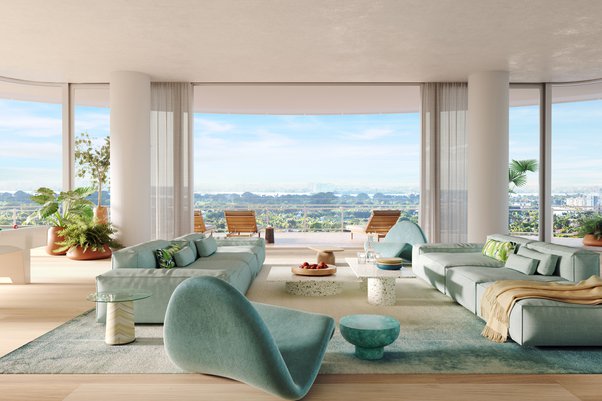
Almost everyone has heard the word. Far fewer people can say what separates a penthouse from an ordinary top-floor flat, or what it really costs to own one. Builders use the word freely, sometimes loosely, so it helps to know what you're being sold before you fall for a rooftop view.
This guide explains what a penthouse apartment is, where the name comes from, how it differs from a regular apartment, what it costs, and what can go wrong. At Greywood Homes, we read two recent buyer guides, a lender's explainer, a Pune market comparison, and an etymology reference to put it together. Several of the cost figures online are unsourced, and where that's the case, we've said so. Greywood Homes is a property marketplace for Agra, Mathura, and Vrindavan, so we also cover what to ask if you're looking at a penthouse in this region.
A penthouse apartment is a high-end unit on the top floor, or one of the top few floors, of a building. Buyer guides describe it as a high-end apartment at the top of a tall building, with most penthouses spread over two floors. It is usually set back from the main façade, creating a private terrace.
A lender's explainer lists three common types in India: single-level penthouses, duplexes (two or more floors), and "sky villas," which are ultra-luxury units with features like a private pool or garden. One caution from a Pune market guide: developers sometimes use "penthouse" loosely for any top-floor unit, so check what the project actually offers.
Most penthouses share a handful of features:
"Pen," "house," and many modern meanings have nothing to do with the origin of the word. Pentis first appears around 1300. This word is derived from Old French and means “appendage” or “attached building.” A sloped building or roof attached to a larger building. Even medieval homilies referred to Jesus’s birthplace, the stable, as a “penthouse,” to emphasise how humble a structure it was.
Spelling as it is known today developed in 1530 as people made a connection to the French word for “slope” (pente) and “house.” Modern usage of the word for a penthouse unit atop an apartment building has only been around since 1921. That’s when it gained the reputation of a luxury term.
At Greywood Homes, we explain it this way: the short version is that a penthouse trades convenience for space, privacy, and views. This is how the sources compare them:
|
Regular apartment |
Penthouse |
|
|
Location |
Any floor |
Top floor or top two floors |
|
Space |
Standard layout, small balcony |
Larger area, private terrace, sometimes two levels |
|
Privacy |
Neighbours above and below |
Fewer neighbours, sometimes private access |
|
Price |
Lower |
Higher, because of size, location and features |
|
Maintenance |
Shared building upkeep |
Higher, because of terrace, larger area and weather exposure |
|
Resale |
Larger buyer pool |
Smaller buyer pool, may take longer |
|
Availability |
Many units |
Usually one or two per building |
The honest answer is that it varies with the location, the project, and the scale. The spread is also huge. An article published in 2026 for lender customers mentioned the price range for penthouses in Mumbai is ₹10 - ₹100 crore, while in Delhi it is ₹6 - ₹50 crore. It also included Bangalore at ₹5 - ₹40 crore, Pune at ₹4 - ₹25 crore, and Hyderabad at ₹3 - ₹20 crore. These prices apply only to large metro cities and shouldn't be considered in the case of small towns.
More pertinent is the premium of a regular apartment in the same area. A market guide in Pune noted a premium range of 40 to 60 percent for PCMC and a range of 45 to 70 per cent for Wakad and Balewadi, and a range of 55 to 80 percent for Baner and Aundh, although there were some projects that commanded even higher. That guide didn’t include the source, so take it as a rough estimate of the possible difference rather than the gospel.
We couldn’t find confirmed penthouse price data for Agra, Mathura, and Vrindavan. The most practical approach to finding the price of a penthouse is to compare the prices given by the builder for a standard flat and a top floor unit, taking the difference on a per square foot basis. Make sure you check if the builder has included the area of the terrace in the unit.
Under-delivery is the other risk. Greywood Homes advises checking what is actually included in the sale, which brings us to buying one.
Penthouses look great in brochures, and their downsides are easy to miss. These are the problems the sources flag:
Yes, if the project you're looking at has one. Because penthouses are few in number, builders often sell them last or only on request. Before you pay anything, Greywood Homes suggests checking the following:
Financing needs extra care. The Pune guide also says banks value a property using registered comparable sales, and penthouse comparisons are scarce, so a bank's valuation may come in below the asking price. That isn't proven by data, but it is a good reason to ask your lender for a provisional valuation before you book. Our home loan EMI calculator can help you work out what the EMI would be.
Good penthouse design is mostly about using the terrace well and protecting it from the weather. The sources and common practice point to these ideas:
Some people search for a "penthouse house". There's no formal category for it, but they usually mean a duplex or sky-villa style home, with its own staircase and terrace, that feels like a house on top of a building.
Yes, it could be, but not necessarily so. The best possible example would be an exceptional unit in a great location with legitimate terrace rights. The downsides are the small secondary market for such units and increased costs associated with holding them. In the case of the Pune guide, it is shown that the gross yield of penthouses (approximately 2.1-2.4 percent) is less compared to the yield of regular 3 BHKs (approximately 2.7-2.8 percent), but even in this case, there is no source is provided.
A penthouse tends to suit you if you:
Penthouses are much less common in the smaller cities, and there is no price data for penthouses in Agra, Mathura, and Vrindavan. In case you would like to purchase a top floor or duplex apartment in any of these cities, you should contact the builder personally and ask if such an option is available, what the terrace offers, and how much more expensive it is compared to a standard apartment. Make sure that the project is registered with the UP RERA and approved by the Agra Development Authority or the Mathura-Vrindavan Development Authority (MVDA).
Greywood Homes provides a list of developer projects and real estate without brokers in all three cities, so you can find your ideal option and make a direct enquiry. You may also call us at +91 72170 39714.
Answers to common questions related to this topic.
Greywood Homes is a property expert sharing insights about the real estate market.
Vrindavan property investment guide: flats vs plots compared on price, rent, loans and legal checks....
Home loan EMI guide for Agra, Mathura and Vrindavan: local areas and prices, EMI examples, interest ...
Noida to Vrindavan property investment: compare rental income, entry cost, yield claims and risks fo...